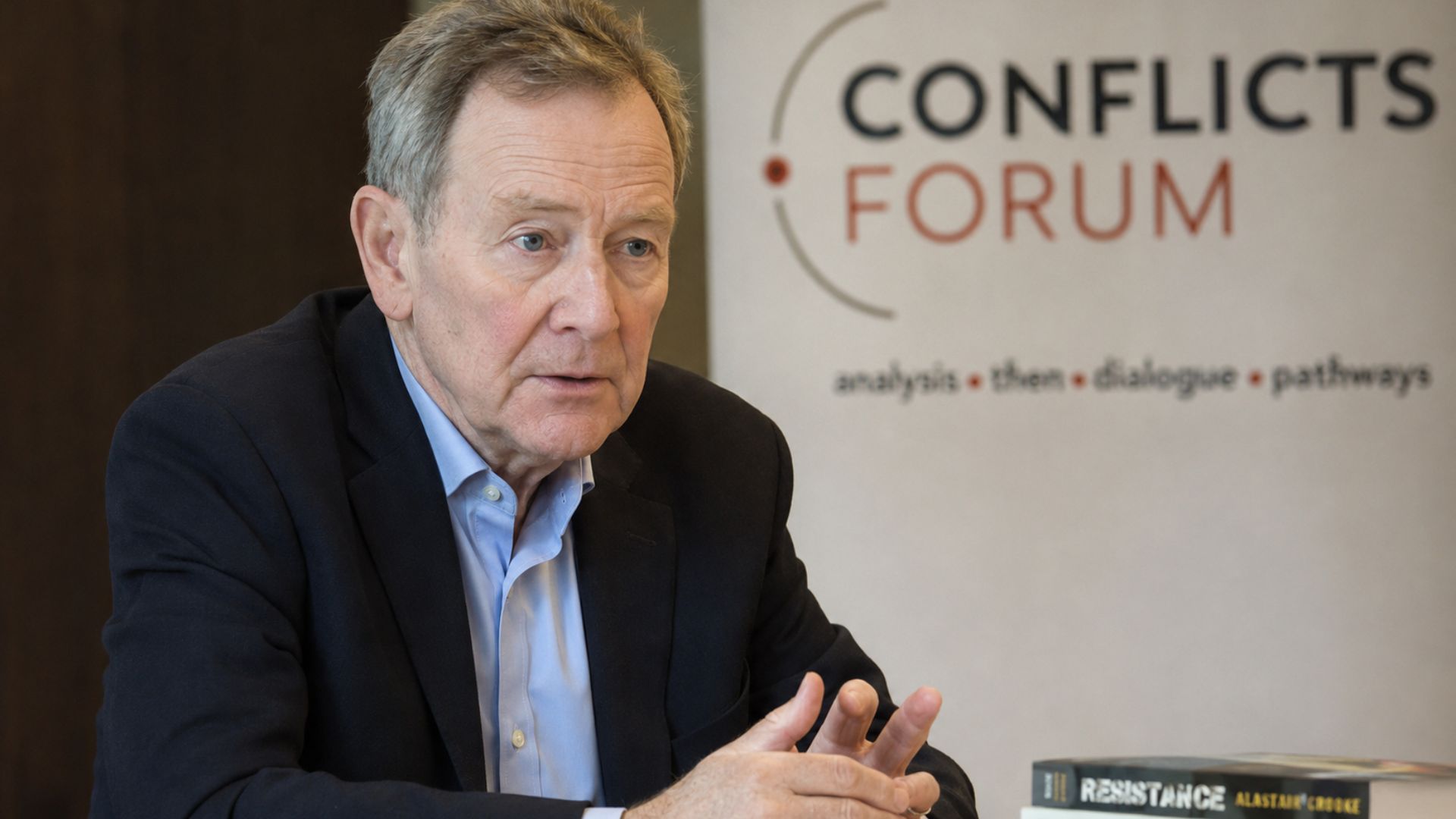

Alastair Crooke is a British former diplomat, intelligence professional, author, and geopolitical commentator whose career has been closely connected with some of the most complicated conflicts in the Middle East. He became particularly well known for his work with the European Union in the late 1990s and early 2000s, when he was involved in efforts to establish dialogue with Palestinian Islamist movements, including Hamas and Islamic Jihad. Later, he founded Conflicts Forum, an organization focused on political Islam, Middle Eastern affairs, and relations between the Muslim world and the West. His career and outspoken geopolitical analysis have made him a distinctive and sometimes controversial figure in discussions about international politics.
Quick Bio of Alastair Crooke
| Detail | Information |
|---|---|
| Full Name | Alastair Warren Crooke |
| Date of Birth | June 30, 1949 |
| Birthplace | Dún Laoghaire, Ireland |
| Profession | Former diplomat, intelligence professional, author, geopolitical commentator |
| Education | University of St Andrews |
| Known For | Middle East diplomacy, conflict resolution, political analysis |
| Former EU Role | Adviser on Middle East issues to Javier Solana |
| Organization | Founder and Director of Conflicts Forum |
| Major Book | Resistance: The Essence of the Islamist Revolution |
| Main Areas of Interest | Middle East, political Islam, geopolitics, international relations |
The biographical record identifies Crooke as having been born in Dún Laoghaire, Ireland, in 1949 and educated at the University of St Andrews. His professional life eventually took him into British intelligence and diplomatic work before he became involved with European efforts to address the Israeli-Palestinian conflict.
Early Career and Diplomatic Background
Much of Alastair Crooke’s professional reputation comes from his experience in conflict resolution. According to biographical material published by Conflicts Forum, he spent decades working in areas involving conflict and diplomacy, with experience extending beyond the Middle East to places including Ireland, South Africa, Namibia, Afghanistan, Cambodia, and Colombia. This background helped shape his approach to international disputes, particularly his belief in maintaining communication with groups that governments may find difficult to engage directly.
Crooke later became associated with British intelligence and was seconded to the European Union. During this period, he worked as an adviser on Middle East issues to Javier Solana, who served as the EU’s foreign-policy chief. His role placed him close to efforts aimed at reducing violence and encouraging negotiations between competing parties in the Israeli-Palestinian conflict.
His professional background was unusual because it combined intelligence experience with diplomacy and direct conflict mediation. That combination became particularly important during his work with Palestinian political and militant organizations.
Work With Hamas and Palestinian Groups
One of the most significant chapters in Crooke’s career involved his communication with Hamas and Islamic Jihad. During his EU assignment, he worked to establish channels of communication with groups that were generally difficult for Western governments to approach directly.
The Guardian reported in 2003 that Crooke had become an important Western communication channel with Hamas and Islamic Jihad. The newspaper also described his work in relation to efforts to bring Palestinian groups into the political process.
Crooke’s approach reflected his broader belief that lasting conflict resolution often requires communication with all significant actors rather than dialogue only with groups considered acceptable by governments. His involvement included work connected with Palestinian ceasefires and attempts to reduce violence.
His work also included involvement surrounding the siege of the Church of the Nativity in Bethlehem. Conflicts Forum states that he helped facilitate the end of the 2002 siege and participated in efforts surrounding Palestinian de-escalation.
These activities made him a notable but controversial figure. Supporters viewed direct communication as a practical diplomatic tool, while critics questioned engagement with organizations regarded by Western governments as terrorist groups.
Leaving His EU Middle East Assignment
In 2003, Crooke’s secondment to the EU came to an end. At the time, British authorities publicly cited security concerns. Contemporary reporting noted that he was recalled from the region after his work with Palestinian organizations had attracted considerable attention.
The end of the assignment did not mark the end of Crooke’s involvement in Middle Eastern affairs. Instead, it became a transition toward a different phase of his career, in which he increasingly worked outside government institutions and developed his own approach to understanding political Islam and international relations.
His earlier diplomatic experience remained central to his later writing because he continued to emphasize dialogue, historical context, and the motivations of political movements.
Founding of Conflicts Forum
After leaving government service, Crooke became the founder and director of Conflicts Forum. The organization describes itself as a geopolitical and geofinancial consultancy and identifies Crooke as its director. Its work has focused extensively on political Islam, Middle Eastern conflicts, and the relationship between Islam and Western political systems.
Conflicts Forum became an important platform for Crooke’s ideas and commentary. Rather than approaching political Islam solely through the lens of security policy, his work has frequently attempted to examine the historical, religious, political, and philosophical factors behind Islamist movements.
This approach has helped distinguish Crooke from many conventional foreign-policy commentators. His analysis frequently challenges the assumption that military pressure or political isolation alone can resolve deeply rooted conflicts.
Alastair Crooke as an Author
Crooke’s best-known book is Resistance: The Essence of the Islamist Revolution, published by Pluto Press in 2009. The book examines the development of Islamist political thought and resistance movements, tracing connections between developments in Egypt, Najaf, Lebanon, Iran, and the Iranian Revolution.
The book explores themes including political Shiism, social revolution, power, Western political thinking, and the concept of resistance. Crooke argues that conflicts involving Islamist movements cannot be fully understood without considering the competing values and historical experiences that shape the political outlook of different societies.
The book is significant because it reflects the perspective that has characterized much of Crooke’s career: understanding political movements requires examining the ideas and historical experiences behind them, not simply their military or political actions.
His Geopolitical Commentary
In later years, Crooke became increasingly visible as an independent geopolitical commentator. His discussions have covered subjects including Iran, Israel, the United States, Russia, the Middle East, economic sanctions, and changes in the global balance of power.
A recurring theme in his analysis is the movement toward a more multipolar international system. He has frequently questioned aspects of Western foreign policy and argued that changes in global power require governments to reconsider traditional assumptions about international relations.
It is important, however, to distinguish Crooke’s interpretations from independently established facts. His geopolitical commentary represents his own analysis and predictions, and different analysts can reach very different conclusions about the same international events.
Why Alastair Crooke Remains Notable
Alastair Crooke remains notable because relatively few public figures have moved between intelligence work, European diplomacy, conflict mediation, engagement with Islamist movements, and independent geopolitical analysis.
His career illustrates the complicated nature of Middle Eastern diplomacy. His experience with Palestinian groups demonstrated the potential importance of communication even when political relationships are extremely difficult. His later writing expanded that approach into a broader argument about political Islam and the relationship between Western and non-Western political systems.
Whether readers agree with all of his conclusions or not, Crooke’s career provides an interesting perspective on how diplomacy, intelligence, conflict resolution, and geopolitical analysis can overlap.
Personal Life and Public Information
Compared with his professional career, relatively little reliable public information is available about Crooke’s private life. Most credible biographical material focuses on his diplomatic work, writing, international affairs, and Conflicts Forum rather than his personal lifestyle.
For that reason, claims about his private finances, exact net worth, daily lifestyle, or other personal matters should be treated cautiously unless they are supported by reliable sources. His professional record and published work provide a much stronger basis for understanding his public profile.
Alastair Crooke’s Legacy
Alastair Crooke’s legacy is closely associated with the idea that difficult conflicts cannot always be resolved without talking to the people involved. His work in the Middle East placed him in situations where communication itself was politically sensitive, particularly during his contacts with Hamas and Islamic Jihad.
His subsequent work through Conflicts Forum and his book Resistance extended this philosophy into a wider examination of political Islam and global power. His supporters value his experience and willingness to question conventional assumptions, while critics may disagree with aspects of his interpretation of international affairs.
For readers interested in diplomacy, the Middle East, political Islam, and changing global power structures, Alastair Crooke offers a distinctive case study. His career demonstrates how an individual can move from government service and conflict mediation into independent writing and geopolitical commentary. Today, his name remains associated with debates about the Middle East, Western foreign policy, and the evolution of the international system. For readers looking for broader discussions of notable people, international affairs, and contemporary ideas, Mating Press offers another place to explore such subjects.
FAQs
Who is Alastair Crooke?
Alastair Crooke is a former British diplomat and intelligence professional who became known for his work in Middle Eastern conflict resolution. He is also the founder and director of Conflicts Forum and an author.
When was Alastair Crooke born?
Alastair Crooke was born on June 30, 1949, in Dún Laoghaire, Ireland.
What was Alastair Crooke’s role with the European Union?
He served as an adviser on Middle East issues to EU foreign-policy chief Javier Solana and was involved in efforts to facilitate ceasefires and reduce violence in the Israeli-Palestinian conflict.
What book did Alastair Crooke write?
His best-known book is Resistance: The Essence of the Islamist Revolution, published in 2009 by Pluto Press.
What is Alastair Crooke known for today?
He is known for geopolitical commentary concerning the Middle East, political Islam, international relations, and changing global power structures. He is also associated with Conflicts Forum.
Did Alastair Crooke work with Hamas?
During his European diplomatic assignment, Crooke established communication with Hamas and Islamic Jihad and participated in efforts connected with Palestinian ceasefires and conflict de-escalation.
What is Alastair Crooke’s main area of expertise?
His professional and published work has primarily focused on conflict resolution, the Middle East, political Islam, diplomacy, and geopolitics.
You May Also Readr https://matingpresss.co.uk/