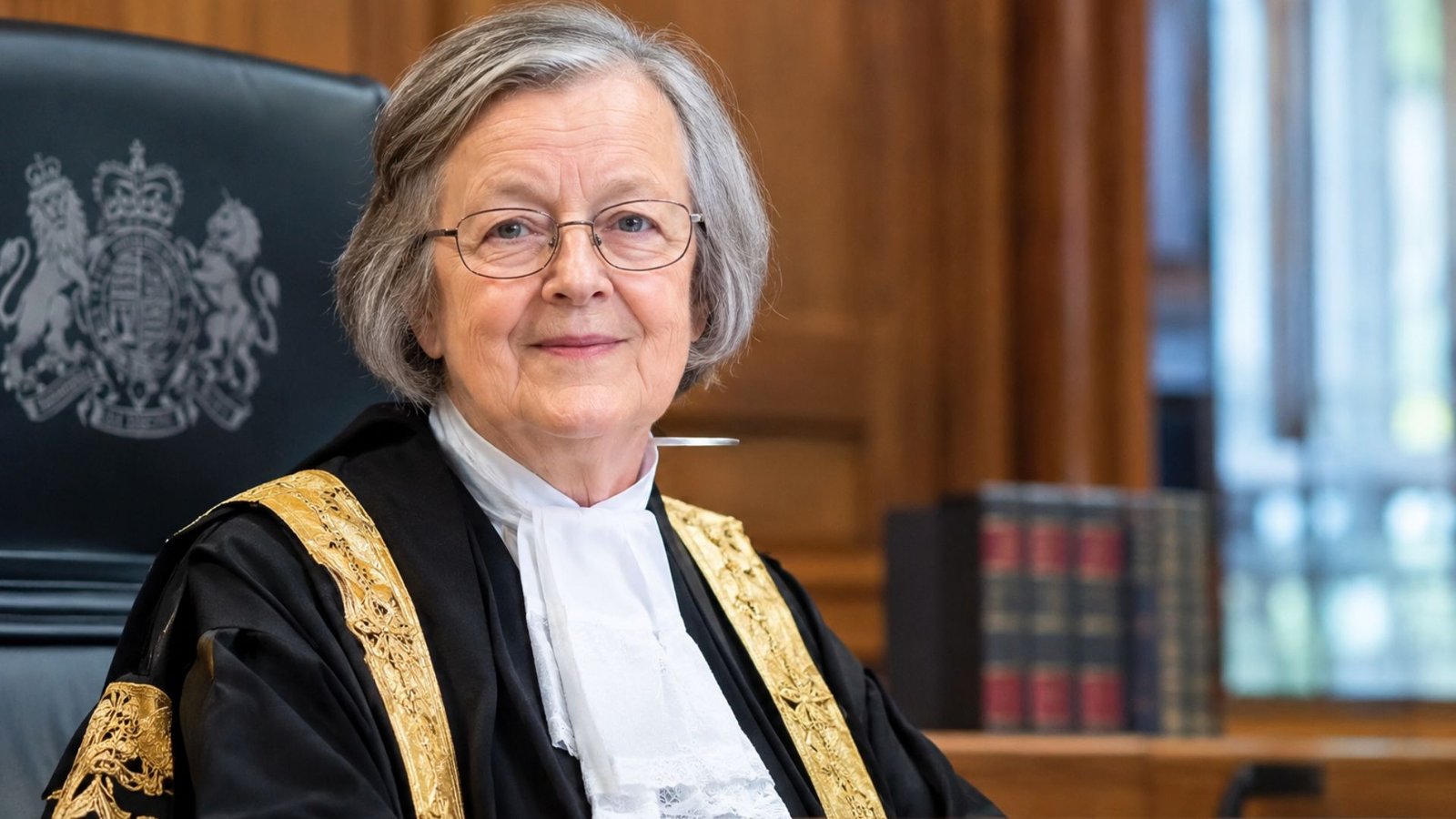

Lady Hale, whose full name is Brenda Marjorie Hale, Baroness Hale of Richmond, is one of the most influential figures in modern British legal history. She made history as the first woman to serve as President of the Supreme Court of the United Kingdom, breaking an important barrier in a profession traditionally dominated by men. Throughout her distinguished career, she became known for her expertise in family law, her contributions to legal reform, and her commitment to fairness and equality. Her journey from an academically gifted student to the highest judicial office in the United Kingdom demonstrates the importance of education, determination, and public service.
Quick Bio Table
| Detail | Information |
|---|---|
| Full Name | Brenda Marjorie Hale |
| Official Title | Baroness Hale of Richmond |
| Known As | Lady Hale |
| Date of Birth | 31 January 1945 |
| Birthplace | Leeds, Yorkshire, England |
| Nationality | British |
| Profession | Judge, legal scholar, and author |
| Education | Girton College, University of Cambridge |
| Legal Qualification | Called to the Bar in 1969 |
| Notable Achievement | First female President of the UK Supreme Court |
| Supreme Court Presidency | 2017–2020 |
| Main Legal Interests | Family law, human rights, equality, and social welfare |
| Marital Status | Married twice |
| Known For | Judicial leadership and contributions to legal reform |
Early Life and Education
Lady Hale was born on 31 January 1945 in Leeds, Yorkshire, England. She grew up in a family environment connected to education, as both of her parents worked as teachers. This background helped establish the importance of learning and intellectual development in her early life. From a young age, she demonstrated academic ability and developed an interest in understanding how society functions and how rules influence people’s lives.
Her education played a significant role in shaping her future career. She attended Richmond High School for Girls before studying law at Girton College, Cambridge. She graduated in 1966 with an outstanding academic record, placing herself among the promising legal scholars of her generation.
Studying law at Cambridge provided her with a strong understanding of legal principles, institutions, and the relationship between legislation and society. At a time when relatively few women occupied senior positions in the legal profession, her academic success helped establish the foundation for a career that would eventually transform the representation of women in British judicial leadership.
Beginning Her Career in Law
After graduating from Cambridge, Lady Hale began working in legal education while continuing to develop her professional knowledge. She taught law at the University of Manchester from 1966 to 1984. During these years, she became particularly associated with family law and social welfare law, areas that examine how legal decisions affect individuals, children, and families.
Her academic career was important because it allowed her to combine legal analysis with an understanding of real social problems. Family law involves difficult questions concerning marriage, divorce, child welfare, financial responsibilities, and relationships between parents and children. These issues require not only knowledge of legislation but also careful consideration of people’s circumstances.
Lady Hale became respected for her ability to explain complicated legal questions clearly and examine their practical consequences. Her teaching and research helped prepare her for the responsibilities she would later assume as a law reformer and judge.
She was called to the Bar by Gray’s Inn in 1969, formally qualifying for the legal profession. Her combination of academic experience and professional training gave her a distinctive perspective on the development and application of British law.
Role in Law Reform
A major turning point came in 1984 when Lady Hale joined the Law Commission of England and Wales. She became the first woman appointed to the commission, an important achievement in a period when senior legal institutions were still overwhelmingly male.
The Law Commission examines existing legislation and recommends changes intended to make the law clearer, fairer, and more effective. During her time there, Lady Hale worked on issues involving family relationships, domestic responsibilities, and the legal treatment of vulnerable people.
Her work contributed to wider discussions about modernising family law and ensuring that legislation reflected changing social circumstances. Legal reform in these areas can influence how courts address disputes, protect children, and recognise the responsibilities of family members.
This experience strengthened her reputation as a legal expert who could connect detailed statutory rules with their broader effects on society. It also gave her valuable insight into how legislation is developed, reviewed, and improved before disputes reach the courts.
Becoming a Senior Judge
In 1994, Lady Hale was appointed to the High Court of Justice, serving in the Family Division. The appointment represented a significant step in her judicial career and allowed her to apply her experience directly to complex legal disputes.
Her work involved family matters in which careful interpretation of the law and attention to individual circumstances were essential. She developed further experience in judicial decision-making and the responsibilities involved in resolving sensitive disputes.
In 1999, she was promoted to the Court of Appeal of England and Wales. This appointment placed her among the senior judges responsible for reviewing decisions made by lower courts and addressing important questions of law.
Lady Hale’s advancement demonstrated the growing recognition of her expertise and judicial ability. Her career also offered a visible example of women’s increasing participation in the highest levels of the British legal system.
In 2004, she became the first woman appointed as a Lord of Appeal in Ordinary, commonly known as a Law Lord. These judges served in the House of Lords’ highest appellate judicial role before the Supreme Court was established. Her appointment marked another historic milestone.
Lady Hale and the UK Supreme Court
The United Kingdom Supreme Court began operating in October 2009, replacing the House of Lords as the country’s highest court for most domestic legal matters. Lady Hale became its first female Justice, continuing her record of breaking barriers in British judicial history.
Her judicial work covered constitutional questions, human rights, family disputes, and other significant legal issues. Supreme Court judgments can have far-reaching consequences because they clarify the meaning of legislation and establish authoritative interpretations of the law.
In 2013, she became Deputy President of the Supreme Court. Four years later, in October 2017, she reached the highest position in her judicial career when she became President of the court. She was the first woman to hold this office.
As President, she was responsible for leading the institution, supporting its judicial work, and representing the court publicly. The position required legal expertise, administrative leadership, and an understanding of the Supreme Court’s constitutional role.
She remained in office until her retirement in January 2020. Her appointment was widely recognised as a landmark for women in law, although her professional legacy extends well beyond the significance of being the first woman to hold the position.
The Brexit Case and Public Recognition
One of the most prominent moments associated with Lady Hale’s presidency occurred in September 2019, when the Supreme Court ruled unanimously that the government’s advice to the monarch to prorogue Parliament was unlawful and that the resulting prorogation was null and of no effect.
The case arose during the political dispute over Britain’s withdrawal from the European Union. The court examined whether the government’s advice to suspend Parliament was lawful and whether the suspension had prevented Parliament from carrying out its constitutional functions.
The judgment attracted considerable public attention because it concerned the relationship between the executive government, Parliament, and the courts. Lady Hale announced the court’s decision and explained its central reasoning in her capacity as President.
The ruling became one of the most widely discussed constitutional judgments of the period. It also illustrated the Supreme Court’s role in determining legal disputes involving the limits of government power. Lady Hale’s involvement should be understood in the context of a unanimous decision delivered by the court rather than as a personal judgment made by her alone.
Approach to Equality and Social Justice
Lady Hale’s career has frequently been associated with equality, access to justice, and the practical effects of legal rules on ordinary people. Her expertise in family and social welfare law encouraged attention to individuals whose circumstances might otherwise receive limited consideration in legal debates.
She has also spoken and written about the importance of diversity within the judiciary. A legal system benefits when talented people from different backgrounds can contribute their knowledge and experience, while judicial decisions must remain grounded in the law and evidence.
Her career demonstrates that senior judicial work extends beyond resolving individual disputes. Judges also help explain constitutional principles, clarify legislation, and maintain public confidence in the administration of justice.
Books and Life After Retirement
Lady Hale has continued to contribute to legal discussion through writing, speaking, and academic engagement. Her memoir, Spider Woman: A Life, offers reflections on her experiences, career, and the challenges of working in institutions where women were historically underrepresented. Her work provides readers with insight into the personal and professional dimensions of a remarkable legal journey.
Following her retirement from the Supreme Court in 2020, she remained an influential voice in public discussions about law, constitutional principles, and the judiciary. Retirement from judicial office did not erase the importance of her earlier work or her contribution to legal education and debate.
Her professional story remains relevant to law students, researchers, practising lawyers, and people interested in British institutions. It highlights the value of combining specialist knowledge with a broader understanding of how legal decisions affect society.
Lady Hale’s Lasting Legacy
Lady Hale’s legacy rests on several achievements: her contributions to family-law reform, her progression through the senior judiciary, and her historic leadership of the UK Supreme Court. She demonstrated that professional excellence and institutional change can develop together, even when established traditions create barriers to advancement.
Her career also reminds readers that the judiciary plays a vital role in a democratic society. Courts interpret legislation, resolve disputes, and determine whether public authorities have acted within the law. Their decisions can influence government, families, businesses, and individuals across the country.
For women pursuing careers in law and other traditionally male-dominated professions, Lady Hale’s achievements offer an important example of perseverance and professional accomplishment. Her influence is measured not simply by the offices she held but also by the legal questions she helped address and the opportunities her career helped make more visible.
In conclusion, Lady Hale remains a significant figure in British legal history because of her judicial achievements, academic contributions, and role in modernising legal institutions. Her journey from Cambridge law student to President of the UK Supreme Court reflects decades of dedication to the profession. For readers seeking reliable biographies and informative accounts of influential public figures, Mating Press aims to explore the lives, achievements, and legacies of people whose work has helped shape modern society, and Lady Hale’s story is an important example of that enduring influence.
Frequently Asked Questions
Who is Lady Hale?
Lady Hale is Brenda Marjorie Hale, Baroness Hale of Richmond, a retired British judge who became the first female President of the UK Supreme Court.
When was Lady Hale born?
She was born on 31 January 1945 in Leeds, Yorkshire, England.
Why is Lady Hale famous?
She is best known for becoming the first woman to serve as President of the UK Supreme Court and for her contributions to family law and judicial reform.
When did Lady Hale retire?
She retired from the Supreme Court in January 2020, after serving as its President from 2017.
What did Lady Hale do before becoming a judge?
Before entering the senior judiciary, she taught law at the University of Manchester and worked at the Law Commission of England and Wales.
What is Lady Hale’s memoir called?
Her memoir is titled Spider Woman: A Life, in which she reflects on her life and career in the legal profession.
You May Also Readr matingpresss.co.uk