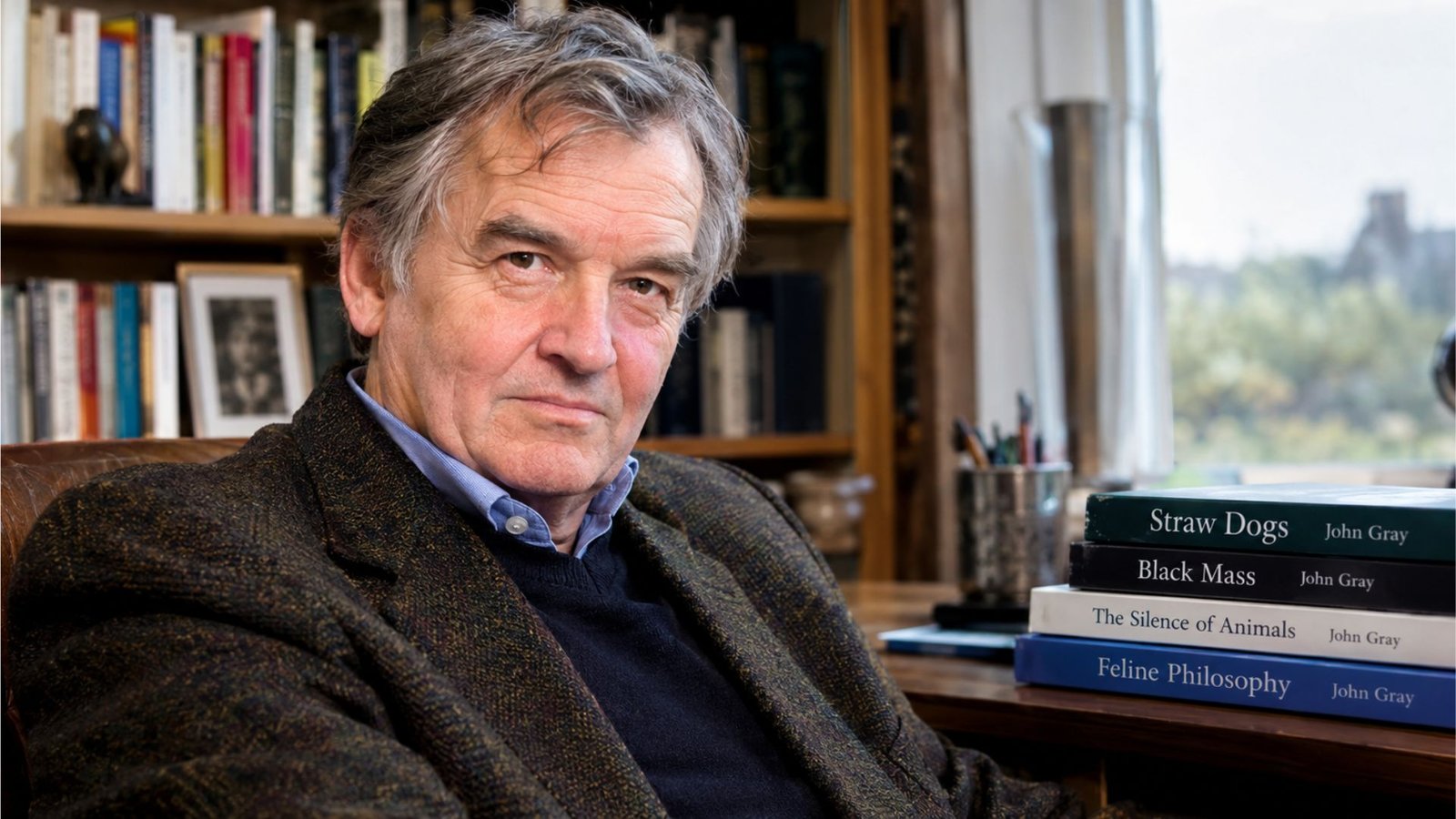

John Gray is an English political philosopher and author whose work has challenged many widely accepted ideas about human progress, modern society, politics, religion, and the relationship between humans and the natural world. Born John Nicholas Gray on April 17, 1948, in South Shields, County Durham, England, he developed a career that combined academic philosophy with accessible cultural and political writing. He became particularly known for books such as Straw Dogs, Black Mass, The Silence of Animals, and Feline Philosophy. His work often questions the assumption that technological advancement and political change necessarily lead to a better human future.
Quick Bio Table
| About | Details |
|---|---|
| Full Name | John Nicholas Gray |
| Date of Birth | April 17, 1948 |
| Birthplace | South Shields, County Durham, England |
| Profession | Political Philosopher and Author |
| Education | Exeter College, University of Oxford |
| Academic Field | Political Philosophy and History of Ideas |
| Former Position | Professor of European Thought, London School of Economics |
| Known For | Straw Dogs, Black Mass, The Silence of Animals |
| Writing Interests | Politics, religion, human nature, progress and philosophy |
Early Life and Education
John Gray was born in South Shields in 1948 and later pursued higher education at the University of Oxford. He studied at Exeter College, where he completed his BA, MPhil and DPhil degrees. His academic training provided the foundation for a career focused on political philosophy, the history of ideas and the development of modern political thought.
Gray’s intellectual interests have never been confined to one political or philosophical tradition. His career has included periods of engagement with liberalism, conservative thought and broader debates about modern political ideology. A University of St Andrews profile from 2000 described his intellectual development as moving from New Right thinking in the early 1980s toward increasingly independent criticism of that ideology. The same source noted that he had advised both Margaret Thatcher and Tony Blair, illustrating the breadth of his involvement in British political discussion.
Academic Career
A significant part of John Gray’s professional life was spent in higher education. He taught at the University of Oxford and held visiting positions at institutions including Harvard and Yale. He later became Professor of European Thought at the London School of Economics and Political Science.
The LSE identifies Gray as an Emeritus Professor of European Thought. He held the professorship from 1998 to 2007 according to an LSE events record, and later retired from academic life. His association with the LSE also included public lectures and discussions covering subjects such as global capitalism, religion, immortality and the meaning of life.
After leaving full-time academic work, Gray continued to write extensively. His work has appeared in major newspapers, magazines and literary publications, allowing his philosophical arguments to reach readers beyond universities.
John Gray and the Idea of Human Progress
One of the central themes in John Gray’s writing is skepticism about the idea of inevitable human progress. Modern societies often associate scientific discovery, technological development and economic growth with continuous improvement. Gray has repeatedly questioned whether these developments automatically make human beings wiser, happier or morally better.
His arguments do not simply reject science or technology. Instead, his work examines the assumptions people sometimes attach to them. Gray has argued that modern faith in progress can resemble older religious beliefs, particularly when people imagine history moving inevitably toward a perfect future.
This theme became particularly prominent in his books about politics, religion and modernity. His writing encourages readers to consider whether some supposedly modern beliefs are actually updated versions of much older hopes about salvation and human perfection.
Straw Dogs and Human Nature
Among John Gray’s most recognized books is Straw Dogs: Thoughts on Humans and Other Animals, published in 2002. The book explores human nature and challenges the idea that humanity stands completely apart from the rest of the natural world.
Gray questions human-centered philosophies that portray people as uniquely rational and capable of mastering nature. He instead emphasizes humanity’s status as an animal species shaped by natural forces.
The book helped establish Gray as a distinctive contemporary philosophical writer because it brought difficult questions about human existence into a relatively accessible form. His examination of animals, consciousness and human self-understanding also became a recurring theme in later works.
Books About Politics and Religion
Gray has written extensively about political ideology and religion. His books include Liberalism, Two Faces of Liberalism, False Dawn, Al Qaeda and What It Means to Be Modern, and Black Mass: Apocalyptic Religion and the Death of Utopia.
In these works, he examines liberalism, globalization, political movements and the belief that societies can be transformed according to comprehensive ideological plans. His analysis frequently connects modern political projects with older religious concepts, particularly ideas involving salvation, historical destiny and the creation of an ideal society.
His approach has made him an influential and sometimes controversial voice in discussions about political philosophy. Rather than presenting political ideas simply as competing programs, Gray often investigates the deeper assumptions about human nature that make those ideas possible.
The Silence of Animals
Another important book is The Silence of Animals: On Progress and Other Modern Myths. In this work, Gray returns to questions about humanity’s relationship with nature and the limitations of the idea of progress.
An LSE discussion of the book described Gray’s interest in the ways humans create myths and ideas that separate them psychologically from their animal nature. The book draws on philosophy, literature and cultural history, demonstrating how Gray frequently combines different intellectual disciplines rather than treating philosophy as an isolated academic subject.
Feline Philosophy
One of Gray’s more unusual books is Feline Philosophy: Cats and the Meaning of Life, published in 2020. Instead of examining politics directly, Gray uses cats as a way of thinking about human existence, happiness, mortality and self-consciousness.
The book considers what humans might learn from the apparent independence and adaptability of cats. Gray explores ideas from philosophers and writers while using feline behavior as a contrast to the anxieties and self-consciousness often associated with human life.
The book demonstrates another characteristic of his writing: he can move from serious philosophical questions to everyday subjects without abandoning the larger questions of meaning and existence. Penguin describes Gray as a political philosopher whose other major books include Seven Types of Atheism, Straw Dogs, Black Mass, The Soul of the Marionette and The Silence of Animals.
Writing Style and Intellectual Influence
John Gray’s writing is notable for bringing philosophical debates to a general readership. His subjects can be complex, but he frequently uses literature, history, religion and contemporary politics to make abstract questions more concrete.
His ideas have attracted both attention and criticism because they challenge optimistic assumptions about humanity and modern civilization. His philosophical outlook is often associated with pessimism, although his books are not simply arguments for despair. Much of his work asks readers to abandon comforting assumptions and look more closely at the limitations of human knowledge and control.
John Gray’s Continuing Legacy
John Gray remains an important figure in contemporary British philosophical writing. His career has connected university philosophy with journalism, cultural criticism and public debate. From his academic work at institutions such as Oxford and the LSE to his books on human nature, politics, religion and animals, he has developed a body of work centered on questioning assumptions about humanity and progress.
For readers discovering his work today, Straw Dogs provides an important introduction to his ideas about humanity and nature, while Black Mass explores politics and utopian thinking. The Silence of Animals continues his examination of human exceptionalism, and Feline Philosophy presents some of his themes through the unexpected example of cats. His work remains relevant to readers interested in philosophy because it asks enduring questions about what humans are, what they can know and whether the future can really be controlled. At Mating Press, readers can explore more profiles of influential thinkers, writers and public figures while discovering the ideas and experiences that have shaped their work.
FAQs About John Gray
Who is John Gray?
John Gray is an English political philosopher and author born in 1948. He is known for his writing on political philosophy, human nature, religion, modernity and the idea of progress.
What is John Gray famous for?
He is particularly known for books including Straw Dogs, Black Mass, The Silence of Animals, Seven Types of Atheism and Feline Philosophy.
Was John Gray a professor at the LSE?
Yes. John Gray served as Professor of European Thought at the London School of Economics and later became an Emeritus Professor.
What is Straw Dogs about?
Straw Dogs examines human nature and challenges assumptions about human exceptionalism, progress and humanity’s separation from the natural world.
What is Feline Philosophy about?
Feline Philosophy uses cats and their relationship with humans as a starting point for exploring happiness, mortality, self-consciousness and the meaning of life.
What subjects does John Gray write about?
His work covers political philosophy, liberalism, religion, human nature, modernity, progress, animals and the history of ideas.
You May Also Readr https://matingpresss.co.uk/