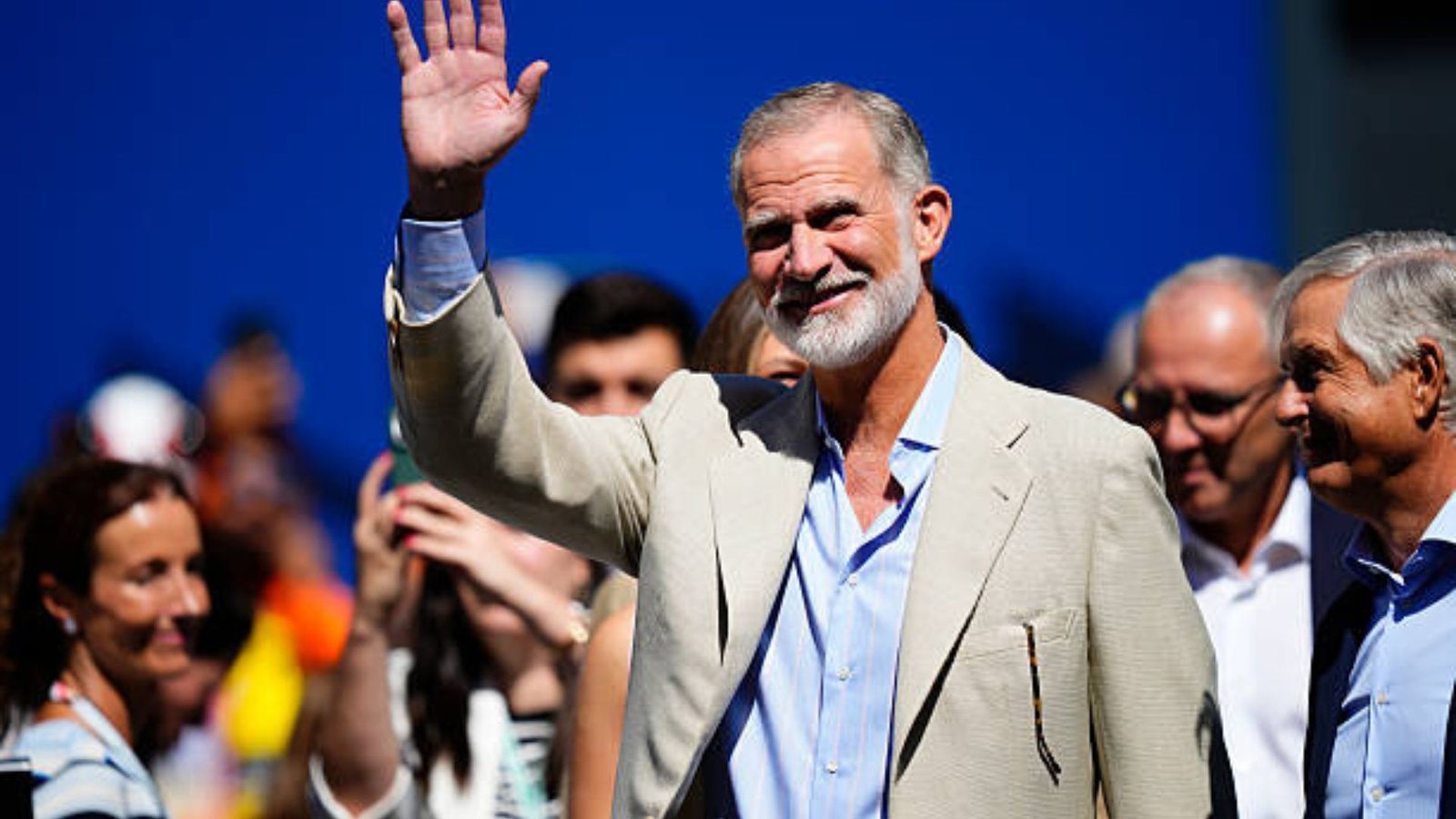

The King of Spain is the constitutional head of state of the Kingdom of Spain, a country whose modern political system is based on a parliamentary monarchy. Since 19 June 2014, the throne has been held by King Felipe VI, who succeeded his father, Juan Carlos I, following his abdication. Felipe VI was born in Madrid in 1968 and spent much of his early life preparing for his future position through academic education, military training, international studies and official public duties. His role as monarch is defined by the Spanish Constitution and includes representing the country, carrying out constitutional responsibilities and serving as an important figure in Spain’s national and international life. His family, particularly Queen Letizia and his elder daughter Princess Leonor, also has an important place in the present and future of the Spanish Crown.
Quick Bio of King Felipe VI
| Detail | Information |
|---|---|
| Full Name | Felipe Juan Pablo Alfonso de Todos los Santos de Borbón y Grecia |
| Royal Name | Felipe VI |
| Date of Birth | 30 January 1968 |
| Place of Birth | Madrid, Spain |
| Father | King Juan Carlos I |
| Mother | Queen Sofía |
| Wife | Queen Letizia |
| Marriage | 22 May 2004 |
| Children | Princess Leonor and Infanta Sofía |
| Became King | 19 June 2014 |
| Predecessor | King Juan Carlos I |
| Royal House | House of Bourbon |
| Heir | Princess Leonor, Princess of Asturias |
| Political System | Parliamentary Monarchy |
| Official Role | Head of State |
| Military Position | Captain General of the Spanish Armed Forces |
Who Is the King of Spain?
The current King of Spain is Felipe VI. He became monarch on 19 June 2014 following the abdication of his father, Juan Carlos I. His accession marked an important generational change for the Spanish Royal Family and placed a new generation at the center of the country’s constitutional monarchy.
Unlike a president or prime minister who exercises executive political authority, the King of Spain serves as head of state. Spain’s Constitution establishes the country as a parliamentary monarchy. Under this system, the King carries out constitutional and representative responsibilities, while the elected government directs domestic and foreign policy and exercises executive authority.
Felipe VI’s official position therefore involves much more than ceremonial appearances. His constitutional duties include formally sanctioning and promulgating laws, proposing a candidate for President of the Government under the constitutional procedure, accrediting ambassadors, representing Spain internationally and exercising other responsibilities established by the Constitution.
The Spanish Government describes the monarch as a symbol of the unity and permanence of the state and as an institution that moderates the regular functioning of constitutional institutions.
Early Life of Felipe VI
Felipe VI was born on 30 January 1968 in Madrid at the Nuestra Señora de Loreto clinic. He was the third child of Juan Carlos and Sofía. His full baptismal name was Felipe Juan Pablo Alfonso de Todos los Santos de Borbón y Grecia.
The names were chosen with connections to different branches of his family and Spanish royal history. Felipe was associated with the first Bourbon king to reign in Spain, Juan with his paternal grandfather Juan de Borbón, Pablo with his maternal grandfather, King Paul of Greece, and Alfonso with his great-grandfather Alfonso XIII.
Growing up as the only son of Juan Carlos and Sofía, Felipe was eventually expected to assume the responsibilities associated with the Spanish Crown. His upbringing therefore included a combination of ordinary education and preparation for future public service.
His childhood and adolescence also coincided with major developments in modern Spanish history. When Juan Carlos became king in 1975, Felipe’s position as the future successor to the Crown became increasingly important.
Education of the King of Spain
Education was an important part of Felipe’s preparation for his eventual constitutional role. He attended Santa María de los Rosales School in Madrid for his early and secondary education. He then completed the final year of his secondary education at Lakefield College School in Canada.
His education later moved into military training and university studies.
From 1985 to 1988, Felipe trained at Spain’s General Military Academy in Zaragoza. He subsequently continued his military education at the Military Naval School in Marín and the General Air Force Academy in San Javier.
His military education resulted in commissions in the Army, Navy and Air Force. He also trained as a helicopter pilot and obtained helicopter pilot wings from the Army and Navy, according to the official biography of the Spanish Royal Household.
Following his military education, Felipe studied at the Autonomous University of Madrid from 1988 to 1993. He graduated with a degree in Law and also studied subjects related to economics.
His education continued outside Spain. In 1993, he enrolled in the Master’s Degree program in International Relations at Georgetown University’s Edmund Walsh School of Foreign Service in Washington, D.C. He graduated in 1995.
This combination of law, economics, international relations and military training gave Felipe a broad educational background before he became King of Spain.
Felipe VI as Prince of Asturias
Before becoming king, Felipe was known as the Prince of Asturias. This was his principal title as heir to the Spanish Crown.
On 30 January 1986, when he reached the age of 18, Felipe swore an oath before the Spanish Parliament. The oath involved loyalty to the King, faithfully performing his duties, respecting and upholding the Constitution and laws, and respecting the rights of citizens and Spain’s autonomous communities.
His official duties increased over the following decades. Beginning in 1990, he made visits to Spain’s autonomous communities to learn more about different parts of the country and meet people and institutions across Spain.
These activities were part of his preparation for the responsibilities he would eventually assume as monarch.
Felipe also represented Spain abroad and attended significant international events. His years as Prince of Asturias gave him extensive experience in diplomacy, public appearances, institutional relations and international representation.
Marriage to Queen Letizia
One of the most significant events in Felipe’s personal life was his marriage to Letizia Ortiz Rocasolano.
Their engagement was announced on 1 November 2003. Letizia was a journalist and television news presenter before becoming a member of the Spanish Royal Family. Their marriage represented an important chapter in the modern history of the Spanish monarchy because Letizia did not come from a royal family.
Felipe and Letizia married on 22 May 2004 at the Cathedral of Santa María la Real de la Almudena in Madrid.
After Felipe became king in 2014, Letizia became Queen of Spain as queen consort. She has since accompanied Felipe at numerous official occasions and carries out her own public responsibilities.
The couple have two daughters, Princess Leonor and Infanta Sofía.
Princess Leonor and Infanta Sofía
King Felipe VI and Queen Letizia’s elder daughter is Leonor, Princess of Asturias. She was born on 31 October 2005 in Madrid.
As the first-born daughter of Felipe VI, Leonor is the heir to the Spanish Crown under the current constitutional succession framework. She therefore occupies a particularly important position in the future of the Spanish monarchy.
Their younger daughter, Infanta Sofía, was born on 29 April 2007 in Madrid. She is currently second in the line of succession after her elder sister.
The two sisters have appeared at various official events with their parents as they have grown older. Princess Leonor’s public responsibilities have gradually increased as she has approached adulthood and taken on duties associated with her future position.
Her role means that the story of the current King of Spain is also closely connected with the next generation of the Royal Family.
How Felipe VI Became King
Felipe VI became King of Spain following the abdication of his father, Juan Carlos I.
Juan Carlos had been king since 1975. In June 2014, he formally abdicated the throne. The required Organic Law was sanctioned on 18 June 2014.
The following day, 19 June 2014, Felipe took the oath required under Article 61 of the Spanish Constitution and was proclaimed King before the Cortes Generales.
He adopted the regnal name Felipe VI.
His accession marked the beginning of a new reign and a transition from one generation of the Spanish Royal Family to another.
The ceremony also highlighted the constitutional nature of the monarchy because Felipe’s accession involved a formal oath to perform his duties, uphold the Constitution and respect the rights of citizens and autonomous communities.
The Constitutional Role of the King
Understanding the King of Spain requires understanding the constitutional system in which the monarchy operates.
The Spanish Constitution establishes Spain as a parliamentary monarchy. The King is the head of state, while the government exercises executive power.
The Constitution assigns the monarch a number of specific responsibilities. These include sanctioning and promulgating laws, convening and dissolving the Cortes Generales in circumstances established by the Constitution, calling elections and proposing a candidate for President of the Government.
The King also formally appoints members of the government on the proposal of the President and issues decrees agreed by the Council of Ministers.
Another major responsibility is international representation. The King accredits ambassadors and diplomatic representatives and represents Spain in international relations.
The Constitution also identifies the monarch as the supreme commander of the armed forces.
However, these constitutional powers operate within a parliamentary system and are subject to the constitutional rules governing the Crown. The Spanish Government explains that acts of the monarch generally require countersignature by the government or the relevant constitutional authority.
King Felipe VI and the Spanish Government
Felipe VI does not function as Spain’s head of government. That responsibility belongs to the President of the Government and the government itself.
The distinction is important because the terms “King of Spain” and “leader of Spain” do not mean the same thing.
The King serves as head of state, while the President of the Government directs government policy and coordinates the work of ministers.
One of the King’s constitutional responsibilities is to propose a candidate for President of the Government after parliamentary elections and according to the procedures established by the Constitution. The candidate must obtain the confidence of the Congress of Deputies before becoming President.
This arrangement reflects the nature of Spain’s parliamentary system, where political authority is exercised through elected institutions.
Military Role of Felipe VI
Military service has been an important part of Felipe’s preparation for the throne.
He trained in all three branches of Spain’s armed forces during his years as Crown Prince. His training included the General Military Academy, the Military Naval School and the General Air Force Academy.
The Royal Household states that Felipe holds the military rank of Captain General of the Army, Navy and Air Force, the highest military rank associated with the supreme command of the armed forces.
His military background is therefore both part of his personal biography and connected with the constitutional responsibilities of the Crown.
International Responsibilities
The King of Spain has an important role in representing the country internationally.
Felipe gained international experience before becoming monarch. As Prince of Asturias, he represented Spain at numerous events and made official visits to different countries.
His international activities as king include meetings with foreign heads of state, diplomatic representatives and international institutions. State visits and official trips can include political, economic, cultural and diplomatic elements.
The constitutional framework specifically assigns the monarch the highest representation of Spain in international relations, particularly in relationships with nations connected to Spain through historical ties.
This makes diplomacy one of the most visible aspects of the King’s public role.
Felipe VI and Spanish Society
The King’s official activities cover many areas of Spanish public life. These can include education, culture, science, business, sports, technology and social initiatives.
As a constitutional head of state, Felipe appears at national ceremonies and events involving public institutions and civil society.
His position also gives him opportunities to meet people from different regions and professional backgrounds. This aspect of the monarchy is connected with the traditional representative function of the Crown.
During his years as Prince of Asturias, Felipe visited Spain’s autonomous communities to become more familiar with the country’s different regions and their institutions. That experience continued to influence his public role after becoming king.
The Royal Family in Modern Spain
The Spanish Royal Family is centered on Felipe VI, Queen Letizia, Princess Leonor and Infanta Sofía.
Each member has a different constitutional or public position. Felipe is the reigning monarch and head of state. Letizia is queen consort. Leonor is heir to the Crown and Princess of Asturias, while Sofía is the younger daughter and second in the current line of succession.
The family is frequently present at national ceremonies, diplomatic occasions and other official events.
Princess Leonor’s development as heir has become particularly significant for the future of the institution. Her eventual succession would represent another generational transition within the Spanish monarchy.
The Spanish Monarchy and the Constitution
The modern role of the King cannot be separated from Spain’s 1978 Constitution.
The Constitution established the political form of the Spanish state as a parliamentary monarchy. It also defines the Crown and lists the monarch’s responsibilities.
The Constitution describes the King as a symbol of the unity and permanence of the state and gives him the role of arbitrating and moderating the regular functioning of institutions.
It also establishes rules governing succession to the Crown.
For this reason, the King of Spain is not simply a hereditary figure without defined responsibilities. His role is formally incorporated into Spain’s constitutional structure.
King Felipe VI’s Place in Spanish History
Felipe VI belongs to the House of Bourbon, the royal dynasty that has played a major role in Spanish history.
His personal story connects several generations of the Spanish Royal Family. His father, Juan Carlos I, became king in 1975, while Felipe became king nearly four decades later in 2014.
Felipe’s reign represents a newer generation of the monarchy. His education was international, his preparation included modern academic disciplines and military training, and his official career included extensive international representation.
His family also illustrates the changing public face of the Spanish Crown. Queen Letizia came to the Royal Family after a career in journalism, while Princess Leonor is being prepared for a future constitutional role as heir.
The Future of the Spanish Crown
Princess Leonor’s position as heir means that the future of the Spanish monarchy is closely connected to the next generation.
Leonor holds the title Princess of Asturias and is first in the line of succession. Her younger sister, Infanta Sofía, follows her in the succession.
As the elder daughter grows into her public responsibilities, she is increasingly visible at official events and ceremonies.
Felipe VI’s role therefore includes not only his own responsibilities as monarch but also the gradual preparation of the Royal Family for the future.
The succession remains governed by the Spanish Constitution, which establishes the rules concerning inheritance of the Crown.
Why the King of Spain Is an Important Constitutional Figure
The King of Spain occupies a distinctive position because he combines the historical institution of monarchy with the modern constitutional structure of the country.
His responsibilities include formal constitutional duties, representation, diplomacy, military leadership under the constitutional framework and participation in significant state ceremonies.
At the same time, Spain’s parliamentary system means that the King is separate from the day-to-day direction of government policy.
This distinction helps explain why Felipe VI’s public role often focuses on state representation, constitutional procedures, diplomacy, national ceremonies and relationships with institutions rather than ordinary executive government.
Personal Life and Public Image
Felipe VI has spent most of his life in public view. From his childhood as the son of Juan Carlos and Sofía to his decades as Prince of Asturias and later his position as king, his personal and professional life has been closely connected with the Spanish Crown.
His marriage to Letizia brought a former journalist into the Royal Family, and their two daughters have become increasingly prominent members of the institution.
The King’s public activities are documented through official royal engagements, speeches, visits and ceremonies. These activities provide a record of his work as head of state and demonstrate the wide range of responsibilities associated with the modern Spanish monarchy.
King of Spain: A Summary of His Life and Role
King Felipe VI’s life has been shaped by preparation for constitutional service. Born in Madrid in 1968, he grew up as the son of Juan Carlos I and Queen Sofía and became the designated successor to the Spanish Crown.
His education included studies in Spain and Canada, military training across the Army, Navy and Air Force, a law degree from the Autonomous University of Madrid and postgraduate studies in international relations at Georgetown University.
As Prince of Asturias, he spent years representing Spain at national and international events. His marriage to Letizia Ortiz in 2004 created the modern royal family that now includes Princess Leonor and Infanta Sofía.
On 19 June 2014, Felipe became King Felipe VI following the abdication of Juan Carlos I. Since then, his position has been defined by Spain’s constitutional framework and his responsibilities as head of state.
The story of the King of Spain is therefore both a royal biography and an explanation of how Spain’s constitutional monarchy works. Felipe VI represents the current generation of the Spanish Crown, while Princess Leonor represents its succession. For readers interested in royal biographies, European history and notable public figures, the life and role of Felipe VI offer a detailed look at one of Europe’s modern constitutional monarchies. For more biographies and detailed profiles of notable personalities, readers can explore Mating Press.
FAQs About the King of Spain
Who is the current King of Spain?
The current King of Spain is Felipe VI. He became king on 19 June 2014 after his father, Juan Carlos I, abdicated the Spanish throne.
When was King Felipe VI born?
Felipe VI was born on 30 January 1968 in Madrid, Spain.
Who are the parents of King Felipe VI?
His parents are King Juan Carlos I and Queen Sofía. Felipe is their third child and their only son.
Who is the wife of the King of Spain?
King Felipe VI is married to Queen Letizia. They married on 22 May 2004 at the Cathedral of Santa María la Real de la Almudena in Madrid.
How many children does Felipe VI have?
Felipe VI and Queen Letizia have two daughters: Princess Leonor and Infanta Sofía.
Who is Princess Leonor?
Princess Leonor is the elder daughter of King Felipe VI and Queen Letizia. She holds the title Princess of Asturias and is the heir to the Spanish Crown.
Who is second in line to the Spanish throne?
Infanta Sofía, the younger daughter of Felipe VI and Queen Letizia, is currently second in the line of succession after her elder sister Leonor.
When did Felipe VI become King of Spain?
Felipe VI became king on 19 June 2014, following the abdication of his father, Juan Carlos I.
What was Felipe VI’s title before becoming king?
Before becoming king, Felipe was known as the Prince of Asturias, the traditional title associated with the heir to the Spanish Crown.
What did Felipe VI study?
Felipe studied Law at the Autonomous University of Madrid and also studied subjects related to economics. He later completed a master’s degree in International Relations at Georgetown University’s Edmund Walsh School of Foreign Service.
Did King Felipe VI receive military training?
Yes. He trained at Spain’s General Military Academy, Military Naval School and General Air Force Academy. He also trained as a helicopter pilot.
What is the political system of Spain?
Spain is a parliamentary monarchy. The King is the head of state, while the government exercises executive authority within the constitutional system.
Does the King of Spain run the government?
No. The King is the constitutional head of state rather than the head of government. The President of the Government directs the government’s political and executive activities.
What are the main duties of the King of Spain?
The King’s constitutional duties include sanctioning and promulgating laws, performing certain functions concerning Parliament and government formation, representing Spain internationally, accrediting ambassadors and carrying out other responsibilities established by the Constitution.
What is the role of Queen Letizia?
Queen Letizia is the queen consort and wife of Felipe VI. She accompanies the King at official occasions and undertakes her own public and institutional activities.
What is the official title of the Spanish heir?
The heir to the Spanish Crown holds the title Princess of Asturias. The current heir is Princess Leonor, the elder daughter of Felipe VI and Queen Letizia.
How long has Felipe VI been King of Spain?
Felipe VI has been King of Spain since 19 June 2014. His reign began after the abdication of Juan Carlos I.
What royal house does Felipe VI belong to?
Felipe VI belongs to the House of Bourbon, the dynasty associated with the Spanish Crown.
What is Felipe VI’s military rank?
The Spanish Royal Household states that Felipe VI holds the military rank of Captain General of the Army, Navy and Air Force, the highest military rank associated with the supreme command of Spain’s armed forces.
You May Also Readr https://matingpresss.co.uk/